
Who Owns It? The Cost of Ambiguity
Why unclear decision rights create escalation dependency and slow organizational execution
Not long ago, I had the honor of visiting a global technology company and sitting in on a strategy meeting with its C suite. The company had successfully launched a new product and was preparing for its next major launch in late 2027.
The leadership team had established clear decision rights. Four leaders would provide critical input: the COO, the CHRO, and the directors of the company’s two largest business units. But the final decision belonged to the CEO.
I remember thinking: This is good leadership.
Everyone knew whose perspective mattered, how their input would inform the process, and who owned the final decision.
| Problems begin when organizations invite everyone into the conversation but fail to name who owns what happens next. |
Everyone is included, but no one is accountable
A senior executive recently described a familiar pattern among new and emerging leaders. An email is sent with six people copied, several perspectives are invited, but no one is told who owns the decision or the next step.
The leader may believe this is collaboration. In practice, it creates ambiguity. People do not know whether they are being asked to provide input, make the decision, complete the work, or simply remain informed.
Having input into a decision is not the same as owning it. Effective collaboration requires both participation and clarity. People need to know whose perspective matters, who has the authority to decide, and who is responsible for moving the work forward.
How ambiguity becomes escalation
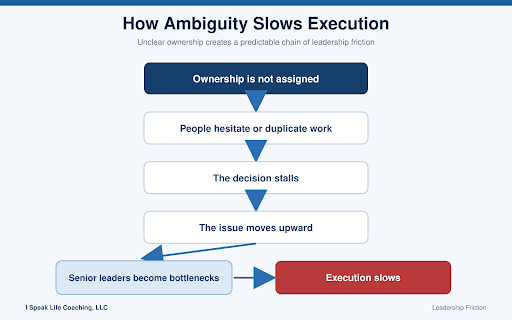
When ownership is unclear, people hesitate, duplicate efforts, or wait for someone else to act. Meetings multiply. Email threads grow longer. Decisions that should be made within the team begin moving upward.
Eventually, a senior leader steps in, not because the decision required senior authority, but because no one else was clearly authorized to make it. This is how ambiguity creates escalation dependency.
How unclear ownership slows execution
The cost is real. Managers spend time correcting or restarting work. Teams revisit conversations they thought were settled. Employees become more cautious and seek approval for decisions they should be equipped to make. Senior leaders become operational bottlenecks, leaving less time for the strategic work only they can do.
The limits of decision making tools
Organizations often use frameworks such as RACI, RAPID, and DARE to clarify roles and decision authority. These tools can be useful. They help leaders identify who provides input, who makes the decision, and who is responsible for execution.
But a framework cannot create clarity by itself. A chart may identify the owner, but it cannot make a leader assign ownership. It cannot make that leader communicate expectations, trust someone to exercise authority, or hold that person accountable for the outcome.
| We do not have a tool problem. We have a behavioral problem. |
Assigning ownership requires courage
New and emerging leaders may hesitate because they do not want to appear controlling. They may fear damaging morale, creating conflict, or placing too much pressure on one person. Leaders who have been promoted from within may find this especially difficult when they are now assigning responsibility to people who were recently their peers.
But refusing to assign ownership is not empowerment. It is ambiguity.
Leaders must be willing to name one owner, define the authority that person has, communicate clear expectations, and establish when escalation is appropriate. They must also trust that person to act and hold them accountable for the outcome.
Clarity at the beginning is far less costly than correcting months of drift. What feels like a difficult conversation today can prevent confusion, frustration, and lost time tomorrow.
Four questions that create ownership
- Who owns the decision?
- Whose input is required?
- What authority does the owner have?
- What would justify escalation?
These questions do not eliminate collaboration. They make collaboration more effective. People can contribute their expertise without becoming joint owners of every decision. Teams can move with confidence because they understand their roles. Senior leaders can remain informed without becoming the default answer to every question.
Decision frameworks can document ownership, but leadership behavior makes ownership real.
Someone must own what happens next.
About David
David Shawn Smith is an executive coach and leadership effectiveness advisor. Through I Speak Life Coaching and Leadership in Practice, he helps leaders reduce organizational friction, strengthen decision discipline, and improve execution.